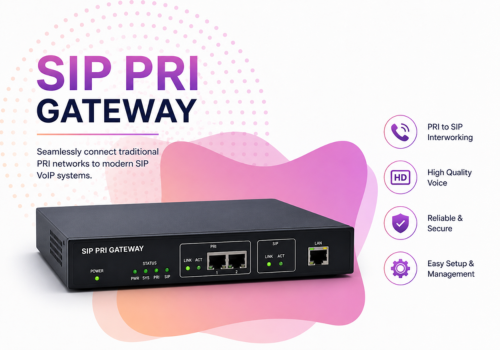
A SIP PRI Gateway or Converter is a device that converts signaling and media between traditional T1/E1 PRI (Primary Rate Interface) lines and SIP
(Session Initiation Protocol) for VoIP (Voice over Internet Protocol) communication. This type of gateway is typically used in businesses or organizations
that have an existing PBX (Private Branch Exchange) system utilizing PRI lines but want to leverage the benefits of VoIP technology.
The SIP PRI Gateway or Converter acts as an interface between the PRI lines and an IP network, allowing for seamless integration of traditional telephony
with VoIP services.
It converts the digital PRI signals used by traditional phone systems into SIP packets that can be transmitted over an IP network,
enabling businesses to make and receive calls over the internet.
By deploying a SIP PRI Gateway or Converter, businesses can maintain their investment in their existing PBX system while also gaining access to the
advanced features and cost savings associated with VoIP communication. This includes features like call routing, call recording, voicemail-to-email
transcription, and integration with CRM systems.
Session Initiation Protocol (SIP) and Primary Rate Interface (PRI) are two popular communication protocols used in the telecommunications industry.
SIP is a signaling protocol used for initiating, maintaining, and terminating real-time communication sessions like voice, video, and messaging
over IP networks.
On the other hand, PRI is a physical interface standard used to connect digital telephony equipment (such as PBX systems) to the public switched
telephone network (PSTN). This tool plays a vital role in facilitating communication between systems that use these different protocols, ensuring
seamless and efficient data transmission.
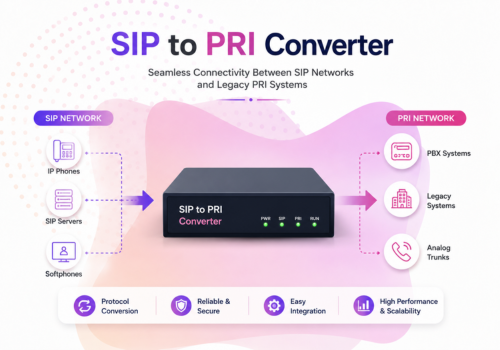
One of the key functions of a SIP to PRI Converter is protocol conversion. When a SIP message needs to be transmitted to a device that uses PRI, the converter
translates the SIP message into a format that is compatible with the PRI protocol. This enables the SIP message to be successfully delivered to the PRI-connected
device, ensuring that communication can take place effectively.SIP to PRI Converters also help in bridging the gap between traditional telephony systems and
modern IP-based networks.
By converting SIP messages to PRI format, organizations can integrate their existing PRI-based infrastructure with newer SIP-based systems without the need
for costly hardware upgrades or replacements. This not only helps in extending the lifespan of current telephony equipment but also allows organizations to
leverage the benefits of IP communications, such as cost savings and enhanced functionality. Another important function of SIP to PRI Converters is to
ensure interoperability between different communication systems. In a heterogeneous network environment where multiple protocols are in use, the converter
acts as a mediator, enabling seamless communication between SIP and PRI networks.
This interoperability is crucial for organizations that rely on various communication technologies to conduct their business operations smoothly. SIP to PRI
Converters offer flexibility and scalability to organizations looking to expand or upgrade their communication infrastructure. These converters can support
a wide range of communication protocols and standards, allowing organizations to integrate different systems and devices as needed. SIP to PRI Converters
play a crucial role in enabling communication between SIP and PRI networks.